
Understanding Litchfield County Busted Mugshots
No single office in Litchfield County holds every booking photo. Torrington Police keep theirs. So do New Milford Police, the other town departments, and the State Police troops that patrol parts of the district. Each arrest file usually holds a face shot plus fingerprints, charging papers, bond or release forms, and a property list. Some agencies label the image a "booking photograph." Others tuck it inside the arrest report itself. Either way, the picture exists in the file. It does not need to appear online to be real.
The layout of the county shapes the hunt. Connecticut disbanded its county sheriffs decades ago, and there is no county jail or county booking desk here. So you start with whoever made the arrest. The official Litchfield Judicial District law-enforcement directory lists each town alongside its municipal department or State Police troop. That map is your first stop whenever the arresting agency is unclear.
It also tells you why broad county searches flop. Troop A, Troop B, and Troop L each cover different towns. Many municipalities run their own desks. Nail down the agency, the town, and the date of the event before you ask anyone for a record.
Litchfield County Busted Booking Records
Booking paperwork varies from one agency to the next, so expect different fields and formats. The details logged when a person is processed are provisional at best. Prosecutors can amend the charge. A judge can dismiss it later. For the true final path of a case, the court docket beats the arrest file every time.
| Field | What it may show |
|---|---|
| Name and identifiers | The person identified during processing, subject to redaction and access rules. |
| Agency and incident number | Who made or processed the arrest and the file number needed for a focused request. |
| Arrest date and time | When the agency says the arrest occurred, which may differ from a news publication date. |
| Charges as booked | Alleged offenses and statutory citations at intake. |
| Bond and release status | The initial bond type or amount and whether police released or held the person. |
| Court date and place | The scheduled venue and next step, which should be checked against the live court docket. |
| Booking photograph | An identification image that may be held in the file without appearing on a public website. |
Request Litchfield County Booking Records
Send the request to the agency that created or maintains the file. A broad request for “all mugshots” is less useful than one tied to a person, date, town, and incident. Connecticut public-record law supports access to public agency records, but exemptions can protect parts of an active investigation, juvenile material, witness or victim information, uncorroborated allegations, and erased or sealed records. Public status also does not require web publication or guarantee release of a photograph.
- Identify the arresting municipal department or State Police troop through the town and incident details.
- Give the full name, birth date if lawfully known, arrest date and time, town, and incident number when available.
- Ask separately for the arrest or booking record and the booking photograph from that event.
- Request an electronic copy, a fee estimate, and all nonexempt portions if part of the file is withheld.
- Ask for a written citation to each exemption used. The Freedom of Information Commission explains the complaint route if access is denied.
State Police material runs through the CSP reports and records process. A nonrefundable $16 search fee applies under C.G.S. § 29-10b. The photo? No promise there. Municipal departments set their own forms and fees, while Connecticut law asks for prompt access but fixes no single delivery deadline.
For a Troop A, B, or L event, use the official CSP request page as the state-level fallback.
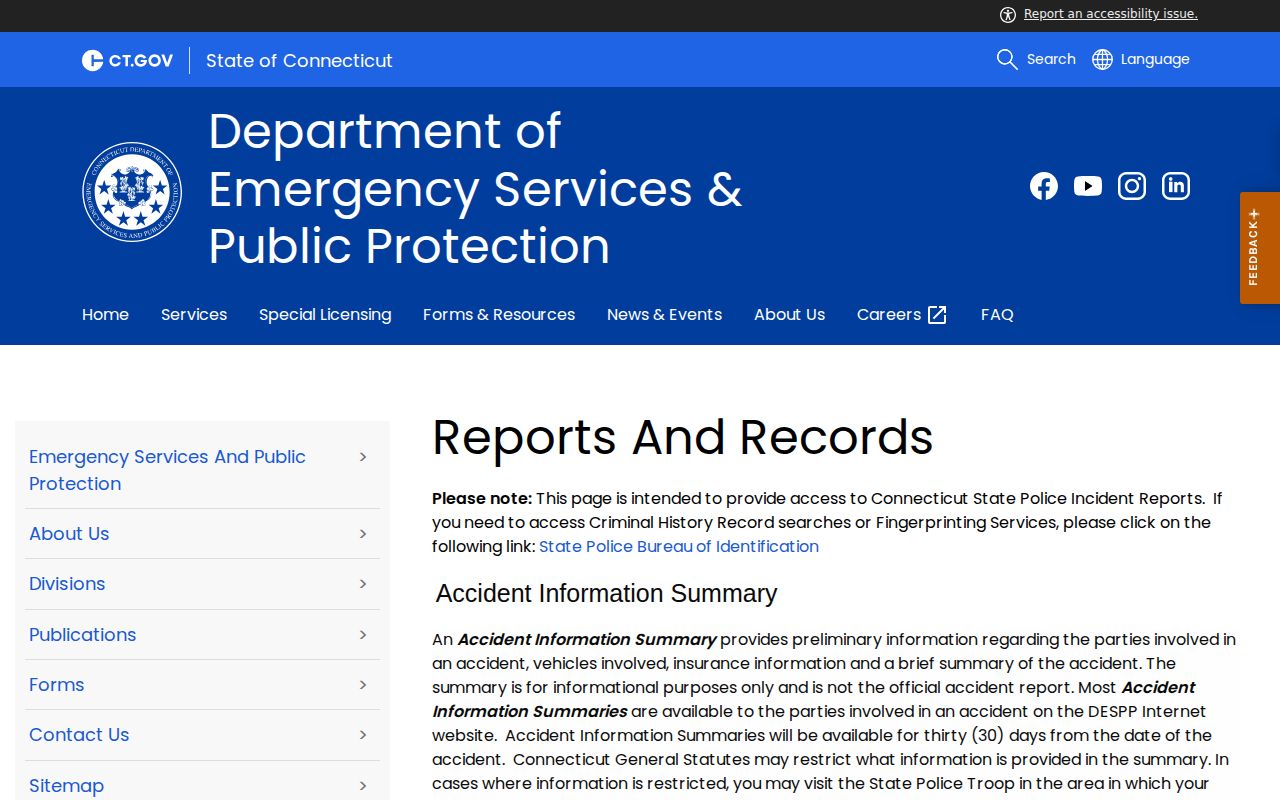
One catch: that interface covers police reports. If you want a booking photograph, name it as a separate record in your request.
Busted Mugshot Law in Connecticut
Connecticut's Freedom of Information Act, mainly Chapter 14 of the General Statutes, builds the public-record framework. It does not build a statewide online mugshot gallery. Section 1-215 sets a floor for certain public arrest information even when another record gets withheld, yet it still does not guarantee a photograph. The custodian has to weigh the actual record, the stage of the case, any exemptions, and erasure or confidentiality rules.
No Connecticut statute currently bans pay-to-remove mugshot publishing. A 2014 legislative hearing aired the idea, but talk is not law. The enacted provisions that matter are C.G.S. §§ 54-142a and 54-142e. The first governs erasure after certain outcomes. The second sets update and deletion duties, within defined terms, on services that pull criminal-matter data in bulk. Neither commands the erasure of every accurate arrest photo on the web.
- Booking
- The agency's intake process after an arrest.
- Bond
- A court or police release condition, sometimes with an amount.
- Disposition
- The court result or resolution of a charge.
- Erasure
- Legal treatment that removes qualifying records from ordinary public access under the governing statute.
- Nolle prosequi
- A prosecutor's decision not to pursue a charge at that time, subject to Connecticut law.
Correct Litchfield County Busted Records
Fix errors at the source. Give the custodian the exact URL or record, the arrest date, the corrected court disposition, and solid documents. Ask plainly whether the agency can repair a factual error, refresh its metadata, pull a stale social post, or note a later result. A court ruling does not rewrite an old press release on its own.
Third-party sites need a different touch. Use each publisher's own free removal policy or contact route. Recently Booked says its removal process is free and weighs several documented outcomes, though it lists no Litchfield County section. Mugshots.com also calls eligible record-maintenance requests free, but its Litchfield category holds zero records. Save the page URL, your submission proof, and the court papers. Nothing is guaranteed.
Watch for scams. Anyone demanding money to reach a free publisher form is not running an official erasure process. Do not pay them. After a source page changes or comes down, an official search-engine outdated-content tool can help clear cached results. It cannot touch a page that is still live.
Protected Litchfield County Arrest Records
Juvenile and erased records are not ordinary old booking pages. Connecticut juvenile matters stay confidential unless a specific law opens them. That protection is strict. Nobody should solicit, collect, or publish juvenile booking photos, and no one should guess a child's identity from family or neighborhood clues in a release.
A missing search result can mean legal protection. It is not a broken database. A qualifying dismissal, a not-guilty verdict, a nolle under the statutory conditions, or similar relief can trigger erasure under § 54-142a. Sealed and erased records should never be rebuilt from cached snippets or unofficial copies. The current court and agency files control.
Archive Litchfield County Arrest Records
Online listings and legal obligations do not match up here. Nothing gets scrubbed after a fixed number of days, because no county roster exists in Litchfield County. State-level retention schedules govern instead, and they differ by agency and record series. Connecticut has no blanket rule for every booking photograph statewide.
So go to the agency that made the record. The records custodian can say which schedule applied. The custodian can also confirm whether the file sits in agency hands, was transferred, or was legally destroyed. Court filings live with the Judicial Branch clerk, while Department of Correction photos belong to the state correctional record system.
Start archival digging with the Connecticut State Archives. Search by creating agency, institution, and record series; the modern county name alone may not lead anywhere. Historical newspapers can supply what was reported at the time. Just never copy a copyright-protected image into a gallery.
Find Litchfield County Busted Mugshots
The right place to look depends on the town and how far custody went. Someone held briefly at a local station may never appear in CT DOC records at all. A person with a filed docket could already be home. Meanwhile, a photo posted online can outlast the case itself.
- Use the official agency-by-town directory to identify the municipal police department or CSP troop.
- Check that agency's current releases, but treat them as selective notices rather than a full booking feed.
- Call the arresting agency's non-emergency line for immediate police custody, then request the specific arrest file and photo.
- Search the Judicial Branch docket after filing and compare identity, court, case number, and event date.
- Use CT DOC only for a person who entered state correctional custody. Use BOP or ICE only for their separate federal systems.
If no photo shows up online, does that mean no arrest happened? Hardly. An agency can keep a booking photograph without ever publishing it, and anyone released before a DOC commitment would never show in the DOC locator. Find the right custodian first. Then verify the outcome with the court.
No Litchfield County Busted Roster
There is no Litchfield County jail roster. None at all. No county sheriff agency runs a current-custody portal, so there are no roster fields, photo rules, refresh intervals, or persistence windows to discuss. Any commercial site posing as the county roster is not an official substitute. That absence is a core fact of how this county works.
| Question | Correct official path |
|---|---|
| Just arrested or at a police station | Contact the arresting department or CSP troop by its non-emergency channel. |
| Criminal case filed | Search the Connecticut Judicial Branch docket and the correct court venue. |
| Entered Connecticut correctional custody | Use CT DOC inmate search and verify the returned identity. |
| Federal or immigration detention | Use the separate BOP or ICE locator. Neither is a county roster. |
Connecticut's state-centered system explains the gap. A courthouse lockup is temporary holding only, and it should never be mistaken for the missing county jail.
No Litchfield County Booking Feed
No official Litchfield County booking feed exists. Not a same-day list. Not a 24-hour or 72-hour roundup, not a weekly log, and no unified arrest archive. There is no county feed photo policy to consult either. What you can find are municipal notices and State Police press releases, both selective by nature. CSP describes its own posts as recent major or high-interest incidents and points readers to the relevant troop for anything else. The official CSP press-release view shows exactly what that feed contains.
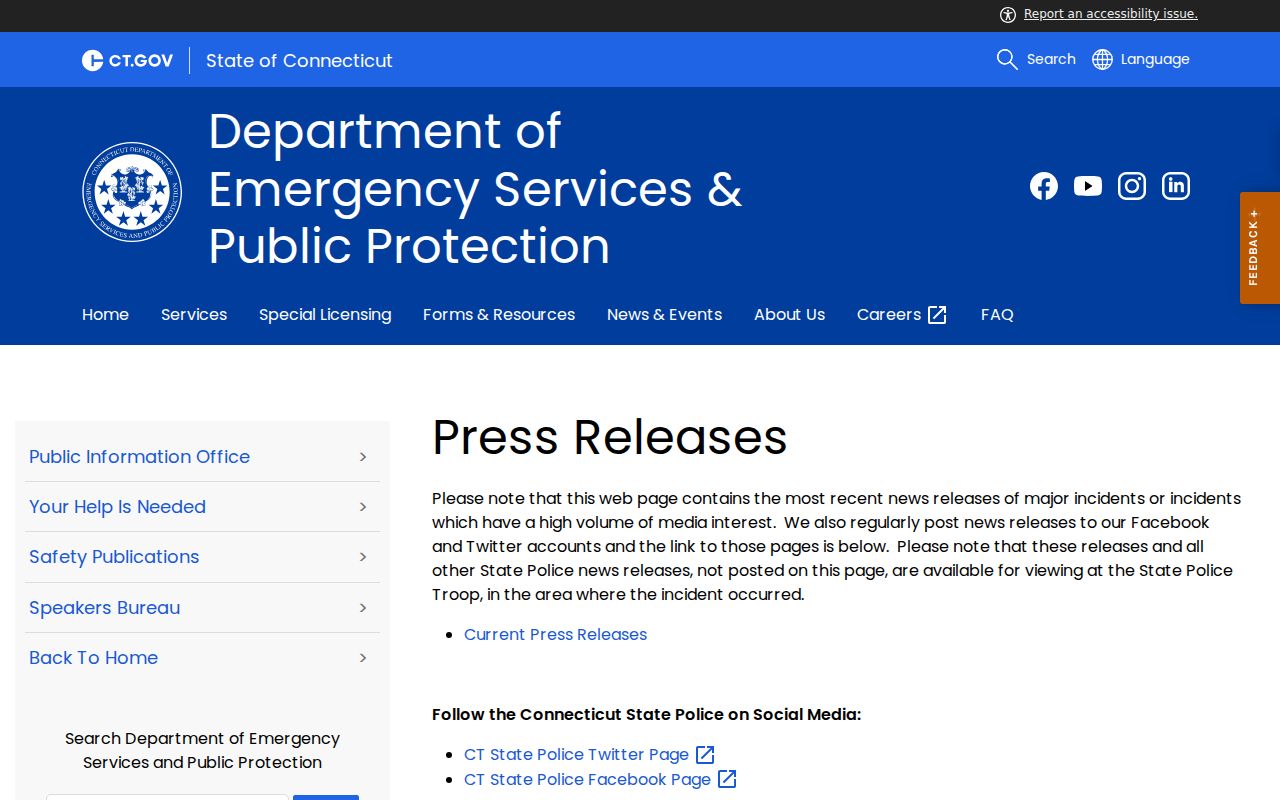
Treat that page as selective, not as a full blotter. A missing name tells you nothing about an arrest, a release, or a court result.
For a fresh event, pin down the town and contact the responsible agency. For an older one, request the agency record and search the court docket. Write down the date of each search. Police custody can shift within hours, and later court entries can change what the initial charge meant.
No Litchfield County Sheriff App
There is no sheriff app here. No hidden app-only roster exists either. No county wanted feed. Municipal and CSP social accounts do post selected notices, but those posts are spotty and follow no set schedule. Reach an account only through a link on the agency's own website. Note each post's date. Confirm the case in court.
Connecticut VINE is a separate opt-in service. It handles safety and status alerts. The state's official victim-information route points to Vinelink for court events and later DOC custody changes within its scope. It is not a mugshot app or a full arrest search. One catch deserves mention: someone registered for court-case notices may need to register again with the inmate identifier to get correctional updates.
Busted Cases Reach Torrington Court
Once a case is filed, the Judicial Branch criminal search becomes the main path. That's how you track its outcome. A disposition is simply the court's resolution of the matter. Names that look alike can be sorted out with lawful identifiers, the court location, the docket number, and the timing of the incident. A docket won't tell you whether someone is still held. It reveals pleas, added charges, continuances, bond events, and results the first police release never could. The official Judicial Branch search form makes one thing clear. This is a case system, not a photo-bearing county roster.
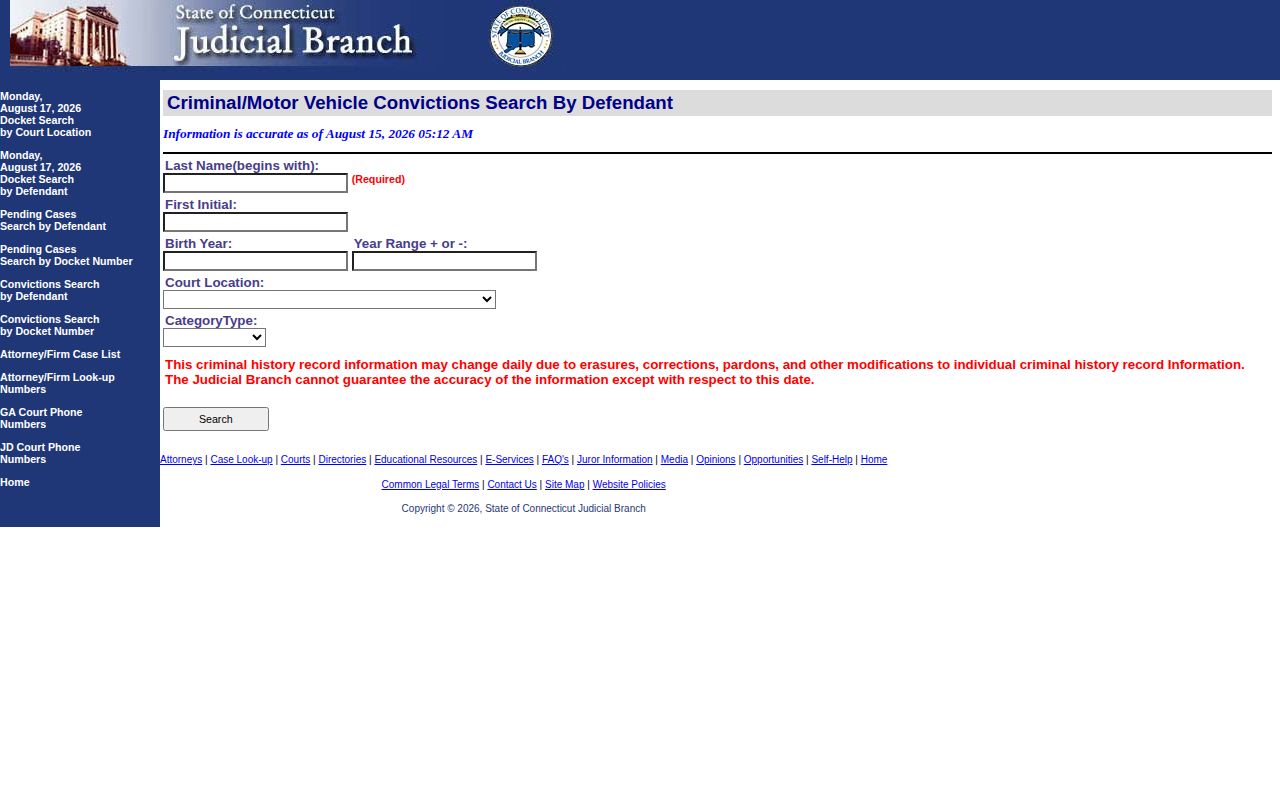
Use the matching docket to avoid freezing the account at the accusation stage. Charges can be reduced, dismissed, nolled, or resolved by acquittal, conviction, or erasure.
Old Litchfield County Court References
Criminal cases here now go to Litchfield Judicial District and G.A. 18. Both sit in the current Torrington courthouse at 50 Field Street. A 2017 consolidation shut the doors in Bantam, Litchfield, and Torrington itself. Everything moved into the new building. Dated articles still send readers to those closed sites, so verify any address an old clipping gives you.
For phone numbers and contacts, trust the courthouse directory over an old clipping. Clerk searches tie to one court location. Copies of court documents run $1 per page. Note: that fee covers court paperwork only, never police booking photographs.
Route Litchfield County Arrest Cases
Venue comes first in any Litchfield County arrest search. The county name alone tells you nothing about which courthouse keeps the file. Connecticut divides its courts into geographical areas and judicial districts, so one town here might route its cases to any of several locations. The official town-to-JD and GA directory pairs each municipality with the correct Judicial Branch office. The type of offense can change the answer too. When you mail a criminal-record request, send it to the geographical-area court where the arrest took place, and include the person's name, birth date, and the arrest date if you know it. That single routing step spares you real headaches. Without it, you risk mailing a closed courthouse or begging one clerk to search every court in Connecticut, which no clerk will ever do.
Litchfield County Booking Photo Policy
No county booking-photo policy exists, and the reason is simple. There is no county jail publishing from a county agency. Each municipal police department or state police troop handles photos it holds. Outcomes vary widely. The record's status, the investigation stage, juvenile protections, victim shields, and erasure law all shape the final answer. Nobody can promise a photo gets released.
A CT DOC image comes from a later state-custody record. It may not match the photo taken at the local arrest you are chasing. Court files rarely substitute for the arresting agency's original picture. Name the exact agency, event, and photograph in every request. Precision matters here, since custody and ownership sit with separate offices.
Litchfield County Busted Record Fees
Fees depend on who holds the record. Connecticut State Police charge a $16 nonrefundable fee for a report search. Court records from the Judicial Branch run $1 per page. The state FOI fee rule caps per-page copy costs differently for state agencies and other public bodies. Municipal forms may carry their own lawful terms. No single price sheet exists. Each custodian sets its own charge, so the total will shift depending on where the busted record lives.
| Record route | Researched fee detail |
|---|---|
| CSP incident-report process | $16 nonrefundable search fee under the procedure cited on the CSP page. |
| Judicial Branch court copies | $1 per page according to the court-record FAQ. |
| State-agency public-record copies | Up to $0.25 per page under the FOI fee provision. |
| Other public-agency copies | Up to $0.50 per page under the FOI fee provision. |
| Estimated charge threshold | An agency may require prepayment when the estimate reaches $10. |
Money questions deserve clear answers up front. Ask for electronic delivery, and get a written estimate before any chargeable work starts. A quick acknowledgment of your request is not the same as actual production, so treat a fast reply as a starting point rather than a finished job. Connecticut's "prompt" response rule sounds strict. It still does not promise records within four business days. The Freedom of Information Commission explains your access rights and the complaint process if an agency stalls. One limit persists, though: the Commission cannot guarantee that any photograph is releasable.
Litchfield County Custody Record Paths
State custody runs through CT DOC, whose database lists people in Connecticut correctional custody. A person's status might read accused, unsentenced, or sentenced. That scope leaves a real gap. Someone processed and released by local police may never show up there at all. Search with an inmate number when you have one; otherwise use a full name and compare several fields to narrow the match. A current DOC record carries plenty of detail: name, inmate number, status, location, controlling offense, admission and release dates, detainer information, and an offender image where policy allows. The CT DOC inmate search is not included here, but the official tool is state-run. Remember what it is: an official custody lookup, not a Litchfield County booking feed.
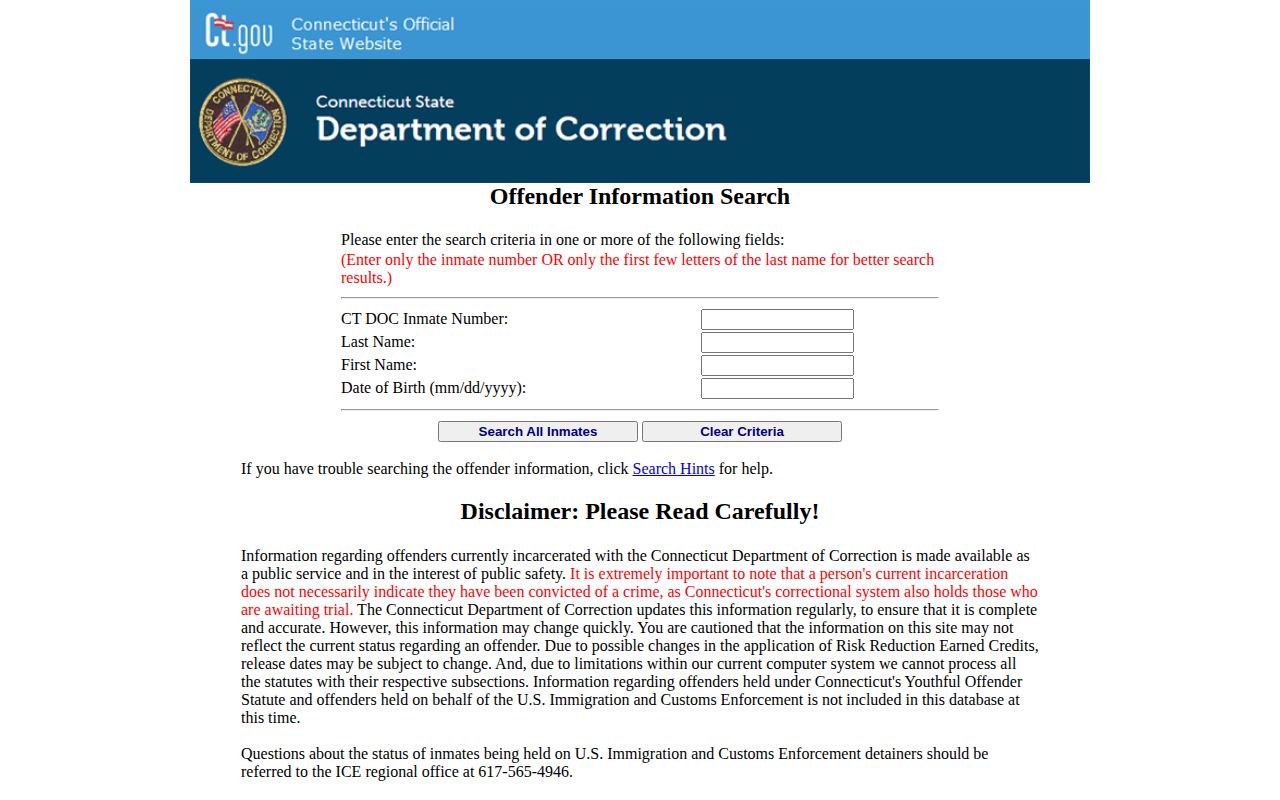
Start with the blank search screen. Leave it empty if you want the widest possible view of what the system will display. A blank result is not final proof that no one is in custody, since lawful youth and safety exceptions can hide certain records from public view.
Federal and immigration custody take separate tools. The BOP inmate locator handles federal prison custody, and it does not publish inmate photographs. For immigration detention, the ICE detainee locator covers qualifying records rather than any local mugshot list. Keep these threads apart in your mind. An ICE detainer, a local criminal case, and a federal custody record are three different matters.
Litchfield County Busted Record Sources
Start with the official trail. The agency that made the arrest holds the freshest file and answers the custody question of the moment. The Judicial Branch takes over once a case is filed, and CT DOC covers anyone moved into state correctional custody. News sites and commercial databases can spark a lead. Just know their data runs thin, stale, or unmoored from how a case later resolved, so lean on them for discovery only.
Local papers add texture, not a full feed. The Lakeville Journal prints a weekly Troop B blotter for the northwest towns, and it stays text-only. Register Citizen and CT Insider track Torrington and the wider region on a rolling basis. The News-Times covers New Milford, while the Republican-American reports across the county. Photo habits differ story to story, and none of these outlets doubles as a booking roster.
Commercial databases fail this county across the board. Busted Newspaper carries no verified Connecticut section at all. Recently Booked's Connecticut index names other counties but skips Litchfield. Mugshots.com's Litchfield County taxonomy sits there empty with zero records on display. Arrests.org and Mugshots.zone offer no usable county section either, so resist the temptation to invent links that patch those gaps.
Does a third-party listing prove current custody? No. Ask the arresting agency first. Then check the court docket, and bring in CT DOC only when state correctional custody applies.
Litchfield County Busted Mugshot Cities
Each town page here grows out of a real local setting. The starting point is always the agency holding the actual police file. Behind these pages sits no fictional county booking office.
- Torrington Busted Mugshots: Torrington Police handles local processing, and applicable cases move to the G.A. 18 courthouse in the same city.
- New Milford Busted Mugshots: New Milford Police is the first contact for a fresh arrest record or booking-photo request.
- Litchfield Busted Mugshots: CSP Troop L is the official starting point, while the county-seat label is historical rather than a sheriff location.
Three custody paths stay separate in every town here. One is the arresting agency's hold. Another is the filed court case. A third is CT DOC custody. No city routes every arrestee into one shared Litchfield County jail roster. Keep those threads apart as you search.